
“Give me a router with the largest antenna. I need the maximum signal coverage.”
If you are a systems integrator or distributor, you have probably heard this claim countless times from your customers. There is a common misconception in the networking industry that the higher the dBi (decibels relative to isotropic) value, the “better” or “stronger” the Wi-Fi signal.
When reviewing product specifications, it’s easy to choose a 15dBi outdoor AP over a 5dBi one simply because the number is higher. However, if you install a 15dBi antenna in a hotel lobby, you’re almost guaranteed to get an angry call from the manager.
Here is the truth about antenna gain, allowing you to build the right Bill of Materials (BOM) for your next project without needing a degree in radio physics.
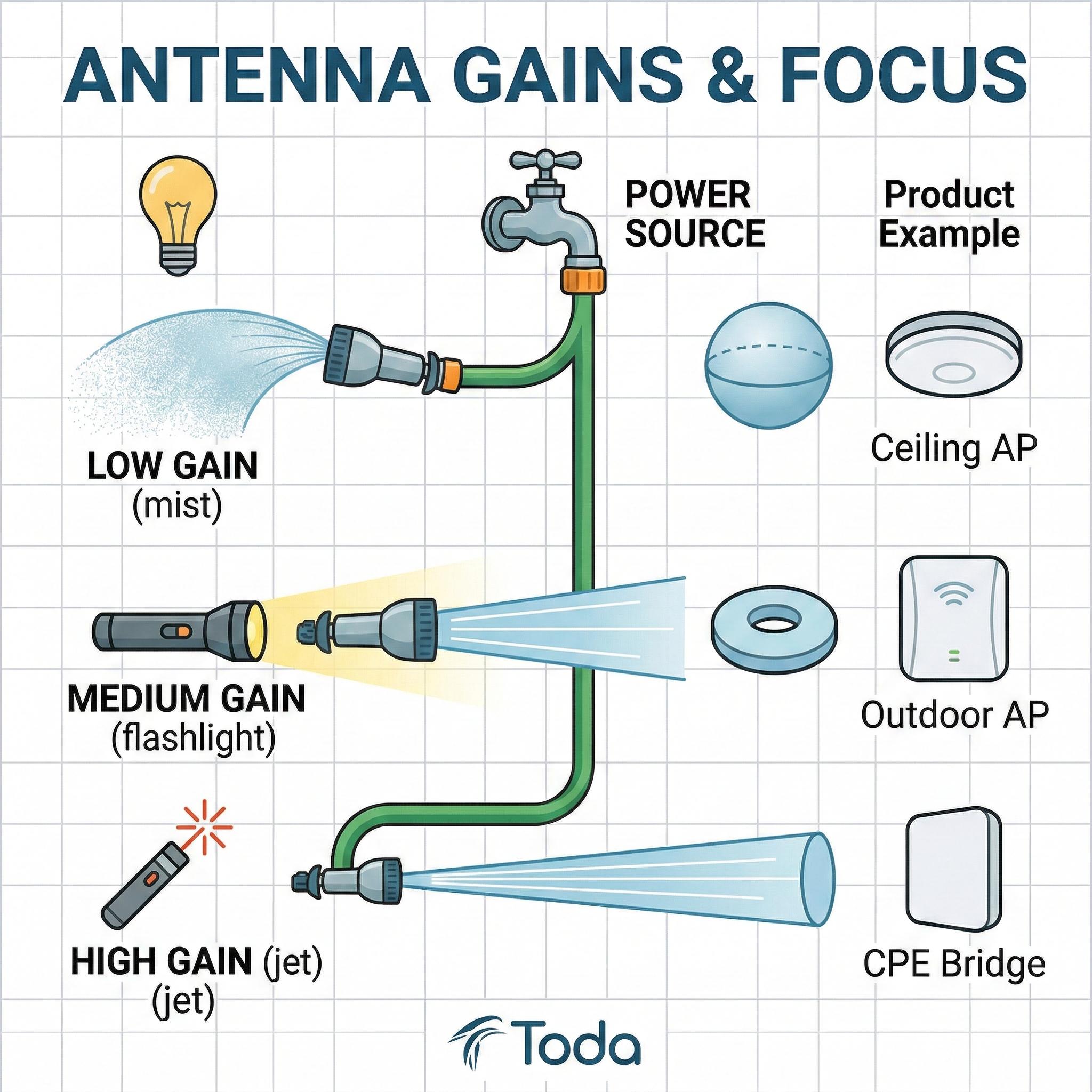
The Golden Rule: Success Comes from Focus, Not Power
The antenna itself does not generate power. The power comes from the radio transmitter inside the router (measured in dBm).
The sole purpose of an antenna is to direct and focus this energy.
Imagine a radio transmitter as a water pipe. The antenna is like the nozzle at the end of the pipe. You’re not increasing the water flow; you’re just changing how the water is sprayed.
Here is the simplest way to understand dBi using the analogy of light:
1. Low Gain (2dBi – 5dBi): The “Bare Light Bulb”
Imagine a bare light bulb hanging from the ceiling. It emits light evenly in all directions—up, down, left, and right. Its illumination range is not huge, but it perfectly covers the entire room.
-
Shape: Perfect sphere.
-
Best Used In: Indoor environments, standard offices, and multi-story residential buildings.
-
Toda’s Solution: Our ceiling-mounted Access Points (APs) feature built-in 3dBi to 5dBi omnidirectional antennas. This ensures a stable connection whether the user is standing directly under the AP or sitting in a corner of the room.
2. Medium Gain (7dBi – 12dBi): The “Flashlight”
Now, put a reflector behind the light bulb to turn it into a flashlight. The light no longer shines backward, but forward, and the beam becomes flatter. It can shine farther, but the coverage angle is narrower.
-
Shape: Flat donut or wide beam.
-
Best Used In: Outdoor courtyards, hotel corridors, and warehouses.
-
The Danger: If a 9dBi omnidirectional antenna is mounted high on a ceiling, the signal will be transmitted horizontally outwards. People standing directly under the antenna may find themselves in a “blind spot” because the signal is literally flying over their heads!
-
Toda’s Solution: Our outdoor Wi-Fi APs typically use 7dBi fiberglass antennas to push signals across parks or parking lots without wasting energy transmitting signals into the sky.
3. High Gain (15dBi – 30dBi+): The “Laser Pointer”
By focusing light of the same intensity through a narrow lens, you get a laser pointer. It can hit a target miles away, but the beam is extremely narrow. If you stand even a meter to the left of the beam, you’ll be surrounded by darkness.
-
Shape: A tight, concentrated cone.
-
Best Used In: WISP deployments, Point-to-Point (PtP) wireless bridging, and connecting two buildings that are miles apart.
-
Toda’s Solution: Our remote CPE bridges utilize high-gain directional panel antennas (18dBi to 23dBi). They are designed to transmit an “invisible fiber” link across valleys. While they provide absolutely no Wi-Fi coverage for smartphones directly underneath, they are ideal for backhaul infrastructure.
Why “More” Can Actually Damage Your Network
Customers make a critical mistake when requesting “high-power, high-dBi” routers for small offices.
-
Multipath Interference: Using a high-gain antenna indoors means the signal hits the walls and reflects off them much faster and harder, resulting in severe multipath interference. Your laptop will receive the main signal, plus five different echo signals reflected back from the walls, causing connection speeds to plummet.
-
The Two-Way Communication Trap: Wi-Fi is a two-way street. Even if you install a giant 15dBi antenna on the roof—providing a signal strong enough to reach a smartphone a mile away—the tiny antenna inside the smartphone cannot transmit a signal back that far. Users will see three bars of Wi-Fi signal but will be completely unable to load any web pages.
The B2B Buyer’s Guide
Don’t just buy products based on the highest dBi value; instead, consider the environmental requirements:
-
High-density indoor areas: Low Gain (Omnidirectional)
-
Wide-area outdoor coverage: Medium Gain (Omnidirectional or Sector)
-
Inter-building links: High Gain (Directional)
At Toda, our engineering team does more than just sell equipment; we focus on designing solutions. If you’re unsure which antenna configuration you need for your next bid, send us your site plan. We will recommend the most suitable hardware configuration to ensure flawless coverage without wasting your budget.
[Contact Toda Engineering for a Free Site Assessment]
Post time: Feb-27-2026


