
Pricing Ethernet switches can be very confusing when preparing a Bill of Materials (BOM) for a large network project.
You search for “24-port Gigabit PoE switch.” One brand quotes $100. Another well-known enterprise brand quotes $800 for a product with seemingly identical specifications.
This massive price gap is frustrating for distributors and system integrators. Are you being ripped off by the expensive brand, or are you buying a substandard product from the cheaper one?
At Toda, we manufacture switches for customers worldwide. We source the raw materials, the chipsets, and the metal casings. Today, we are revealing our cost breakdown. Below is a true, behind-the-scenes analysis of the cost structure of enterprise network switches.
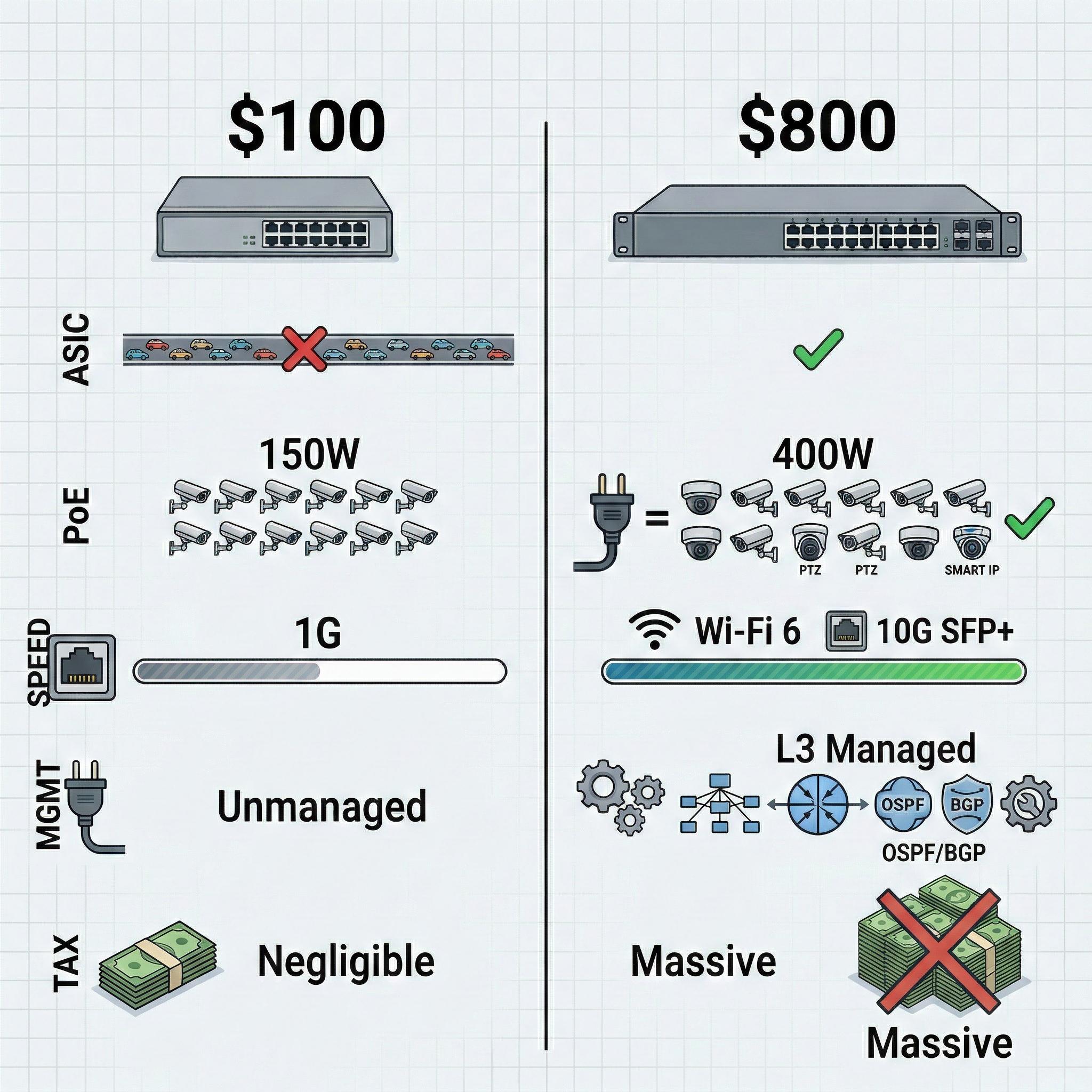
1. The Brain: Switching Silicon (ASIC Chipsets)
The most expensive component inside any switch is the main switching chip (ASIC). It determines the “backplane bandwidth” or “switching capacity.”
-
Entry-Level Options: Inexpensive switches may use budget chips. Although advertised as “Gigabit,” the chip will be overwhelmed if all 24 ports are simultaneously downloading large files. It is physically incapable of handling such a massive amount of data concurrently.
-
Enterprise-Grade Configuration: High-end switches utilize premium chipsets from manufacturers like Broadcom, Marvell, or high-end Realtek series. These chipsets ensure non-blocking line-rate performance. This means that every single port can operate at maximum speed around the clock without any switch lag or packet loss.
Cost Impact: High-performance silicon chips can easily double the manufacturing cost of a motherboard.
2. The Power Plant: PoE Power Budget
If you buy a PoE (Power over Ethernet) switch to run IP surveillance cameras or Wi-Fi 6 Access Points, you are essentially buying a large power supply with data ports attached.
-
The Power Dilemma: You might compare two switches that both feature 24 PoE ports. However, Switch A has a total power budget of 150W, while Switch B has a budget of 400W.
-
The Reality: Switch A can only power a maximum of 10 standard cameras simultaneously before running out of power. Switch B, on the other hand, can power 24 high-power PTZ (Pan-Tilt-Zoom) cameras simultaneously without breaking a sweat.
Cost Impact: High-capacity built-in power supplies and large industrial capacitors are expensive. When you purchase a Toda PoE+ switch, you are paying for power stability, ensuring your cameras remain online even during minor voltage fluctuations.
3. The Highway: Port Speeds and Uplinks
Currently, the manufacturing cost of a standard 1-Gigabit (1G) copper port is very low. However, the cost increases dramatically once you scale up the transmission speed.
-
Multi-Gigabit (2.5G/5G/10G): Upgrading ports to 2.5G (which is rapidly becoming the standard to support Wi-Fi 6 and Wi-Fi 7 Access Points) requires completely different PHY chips. The manufacturing cost increases significantly per port.
-
Fiber Uplinks (SFP/SFP+): Adding a 10G SFP+ slot for fiber optic cables requires a dedicated transceiver cage and a vastly improved thermal design to dissipate heat, which directly increases the final price of the unit.
4. The Software: L2 and L3 Management
Hardware is only half the battle. You also have to pay for the engineers who wrote the software.
-
Unmanaged Switches: Zero software development cost. They are strictly plug-and-play.
-
L2 / Smart Managed Switches: Requires ongoing development to build and maintain a secure Web GUI for features like VLANs, QoS (Quality of Service), and Spanning Tree Protocol (STP).
-
Layer 3 (L3) Managed Switches: These switches function similarly to routers, capable of handling complex IP routing protocols (such as OSPF and BGP). Developing and maintaining this stable, enterprise-grade software requires a dedicated team of software engineers, hence the premium price tag on L3 switches.
5. The Hidden Cost: The “Brand Tax”
Finally, we need to talk about marketing.
When you buy a switch from a massive, global networking brand, the physical hardware itself is only a fraction of what you are paying for. You are actually paying for their global advertising campaigns, stadium sponsorships, and massive corporate headquarters.
In the manufacturing industry, we call this the “Brand Tax.” This premium can account for 40% to 50% of the final retail price you pay.
How to Procure Smarter with Toda
At Toda, our business model is fundamentally different. We are the factory.
We use the same high-end Broadcom and Realtek chipsets as the major brands. We use robust internal power supplies exceeding 400W. We have built comprehensive L2+ and L3 management software. But we have completely eliminated the brand premium.
For B2B distributors and IT contractors, this means you can procure genuine enterprise-grade network equipment at factory-direct prices, allowing you to truly maximize the profit margins on your installation projects.
Want to see the numbers for yourself? Contact Toda today. Send us the specifications of the switch you are currently purchasing, and we will send you the equivalent Toda product spec sheet alongside our factory-direct wholesale pricing.
Post time: Feb-28-2026


