
Nowadays, if you open the datasheet of any wireless router or access point, you will see a bunch of numbers: AC1200, AX3000, AXE11000.
For our distributors and internet service providers, the most frequent question Toda receives is: \”Is tri-band really worth the extra cost, or is dual-band sufficient?\”
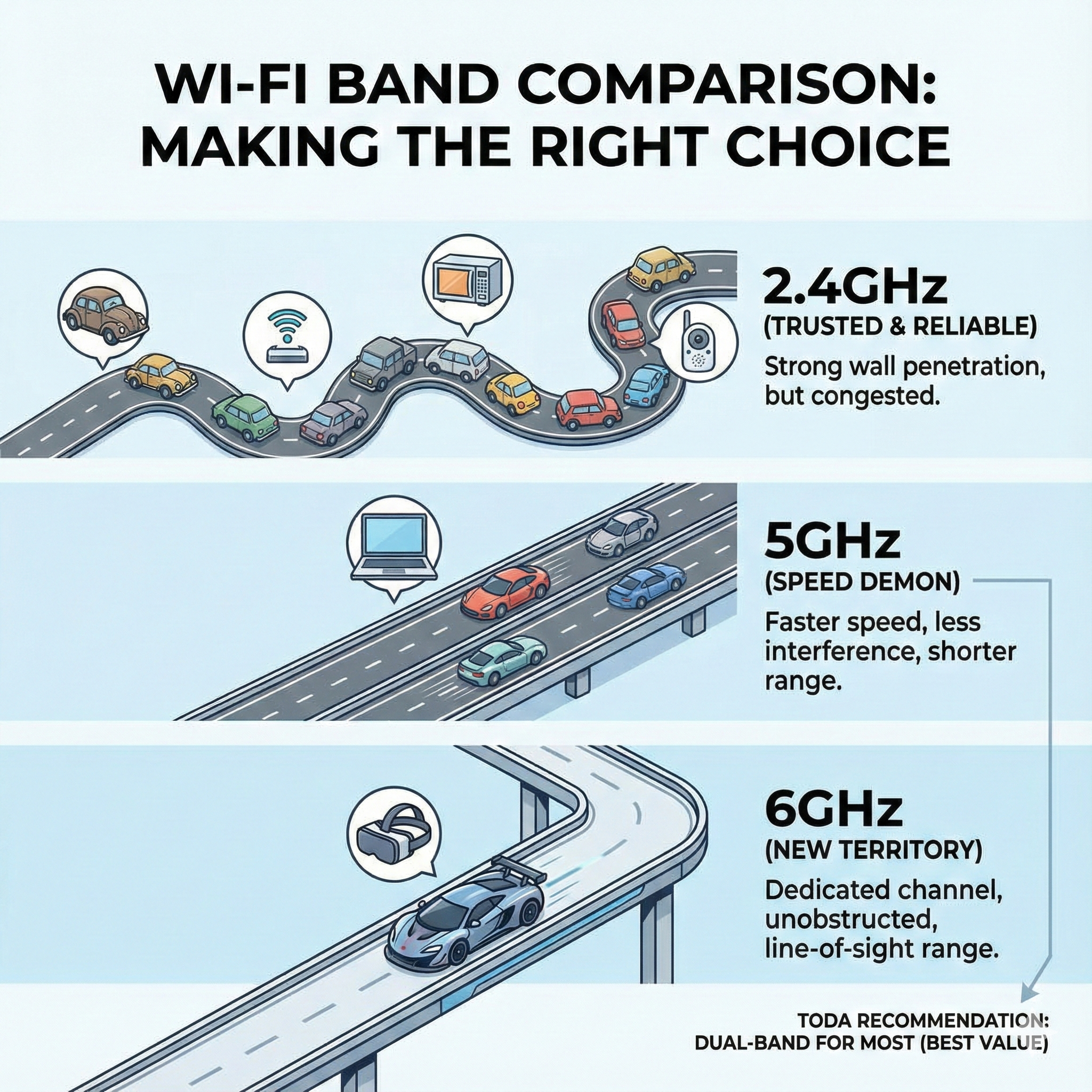
To make the right inventory purchasing decisions, you need to understand the physical path of data transmission. Let’s put aside the obscure jargon and understand the differences between the 2.4GHz, 5GHz, and emerging 6GHz bands.
1. A trusted and reliable choice: 2.4GHz
Imagine the 2.4GHz band as an ordinary, old highway. It has always existed.
Advantages: It has a very strong ability to penetrate walls. Low-frequency signals travel further. If you need to cover a large backyard or thick-walled garage with a simple signal amplifier, 2.4GHz is still the best choice.
The downside: The network is extremely congested. It’s not just Wi-Fi; your microwave, Bluetooth speaker, and baby monitor all consume the line. In a crowded apartment building, this network frequency is practically a traffic jam.
Maximum speed: Typically up to 450-600 Mbps (theoretical value).
2. Speed Demon: 5GHz
This is the standard for modern networks. If the 2.4GHz band is a congested city street, then the 5GHz band is a multi-lane highway.
Advantages: Faster speed, less interference. 90% of video streaming and Zoom calls should take place here.
Disadvantage: Due to the laws of physics, high-frequency signals have difficulty penetrating solid objects. A 5GHz signal will significantly attenuate after passing through two concrete walls.
Application Scenarios: This is the core frequency band of Dongtian’s dual-band APs. For most hotels and offices, a complete dual-band network solution is ideal because one AP can be deployed in each area, effectively solving the problem of insufficient coverage.
3. New Territory: 6GHz (Wi-Fi 6E and Wi-Fi 7)
This is where a tri-band player comes in. A tri-band device adds a third-band radio module that broadcasts on the 6GHz band.
Advantages: This is a dedicated, unobstructed channel. Older devices (such as old phones and laptops) cannot connect at all. It is only open to new, high-performance devices. It is completely unaffected by interference from neighboring old routers.
Disadvantages: Cost and transmission distance. The transmission distance of 6GHz is even shorter than that of 5GHz. Strictly speaking, it can only transmit within “the same room” or “line of sight.” Furthermore, the chipset required to run it is much more expensive.
Business Decision: Which Stocks Should You Invest In?
As manufacturers, we closely monitor global order trends. Here are our recommendations for B2B buyers in 2025:
Please continue using dual-band (Wi-Fi 6) if the following conditions are met:
Target market: budget internet service providers, ordinary households, budget hotels, or rural internet coverage.
Reason: 95% of the devices your customers currently use (smartphones, TVs, etc.) can operate perfectly on the 5GHz band. Dual-band routers offer the best price-performance ratio, being affordable, stable in performance, and fast enough to meet the needs of 4K streaming media playback.
Toda recommends our AX3000 dual-band mesh networking system or ceiling-mounted wireless access point. They are our best-selling products for a reason.
Upgrade to tri-band (Wi-Fi 6E/7) IF:
Target market: gaming cafes, high-tech enthusiasts, upscale corporate offices, or crowded stadiums.
Reason: If you are deploying in a highly turbulent environment (such as a conference center) where the 5GHz band is unavailable, then the 6GHz band is a lifesaver.
Toda’s suggestion: Feel free to consult our high-performance tri-band enterprise-grade APs for specific projects.
Summary
Don’t let marketing campaigns force you to overspend.
For most real-world applications in 2025, Toda’s high-quality dual-band Wi-Fi 6 solution will offer a better experience than cheap, low-quality tri-band routers from generic brands. This isn’t just about the frequency bands, but also about the quality of the antennas and the processing power of the chipset.
Still unsure which model meets your bidding requirements? Please send us your project specifications, and our engineers will recommend the exact hardware configuration you need.
[Contact the Toda Engineering Team]
Post time: Nov-30-2025


