
A ring restores its alternate path quickly, yet the operator still sees a process alarm or a gap in recorded data. Both observations can be true. Network reconvergence and useful application recovery are measured at different boundaries.
A published recovery figure is meaningful only with its topology, protocol, failure type, traffic and measurement method. It should lead to a project test specification, not replace one. The network has succeeded when it supports the application's accepted behavior through the failures the design promises to withstand.
Define three timestamps before discussing milliseconds
Identify the initiating failure, the restoration of the required forwarding path and the return of useful application service. The intervals between them reveal where time is spent. A link-state event in a switch log is not necessarily the moment the application loses or regains data.
The application may need to re-establish a session, wait for a timeout or recover state after traffic returns. Other network functions, such as multicast membership and address learning, may also affect particular flows. Measure those effects where they matter to the service.
Avoid comparing two vendors' figures until the test boundaries are comparable. One may report a protocol transition under a defined link fault; another may report packet interruption in a different topology. A smaller number is not automatically the better match for the site's application.
Start with the topology and protocol actually being purchased
RSTP, an Ethernet ring protection mechanism and a duplicated-network architecture do not have identical behavior. Verify the supported protocol, required roles, topology limits and interoperability for the exact equipment and software revisions.
The TODAHIKA TH-G510-8E2SFP page lists redundant-network functions. Obtain the applicable configuration guide and conditions behind any proposed recovery claim. Do not assume that every redundancy function listed for a family can be combined freely in one topology.
Cisco's industrial automation design guide treats resiliency in the context of topology and traffic. Its test results belong to its documented arrangements; they are not substitute performance data for a different switch network.
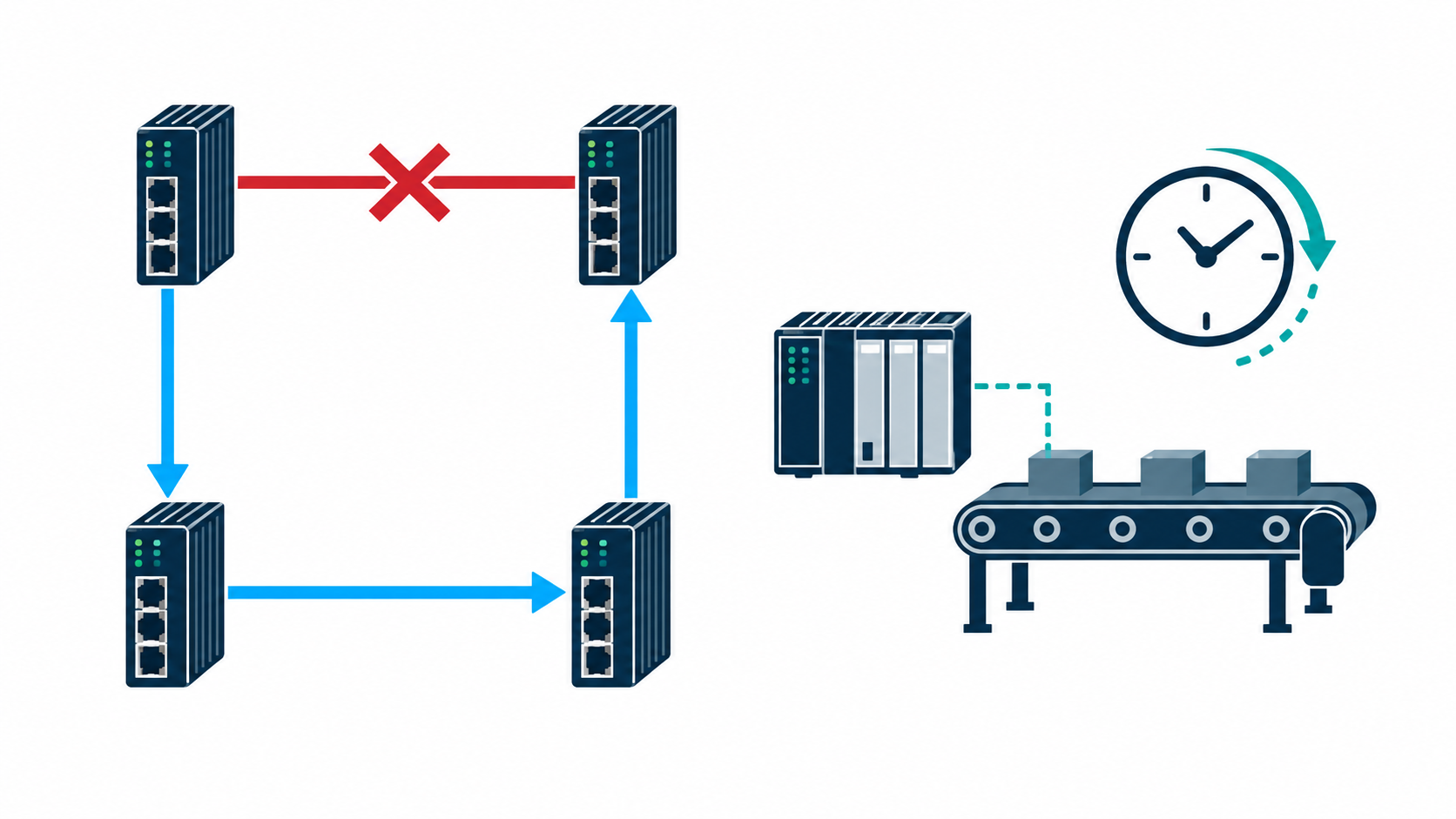
Turn the process requirement into a measurable acceptance limit
Ask the application owner what interruption can be tolerated and how it is detected. A supervisory display, a camera recorder and a cyclic control exchange can have very different requirements. “The network should recover quickly” is too vague to test.
For an illustrative case, suppose an application expects an update every 20 ms and raises a communications alarm after 150 ms without a valid update. A test should observe valid update arrival and the actual alarm behavior. A periodic ping that runs once per second cannot establish whether that 150 ms condition was violated.
The example is a method for defining the measurement, not a recommendation for control-system settings. Keep the application's approved timing and behavior unchanged while evaluating whether the proposed network meets it. Any process-setting change belongs to a separate reviewed decision.
Define the relevant traffic direction and load. A test of one unicast stream may not establish the behavior of multicast receivers or a routed application. Include the services the site actually needs during the failure.
Build a fault matrix around plausible single failures
| Failure or transition | Network evidence | Application evidence |
|---|---|---|
| One selected ring link is interrupted | Port event and forwarding-path transition | Missing data interval and continuity of the required service |
| Another ring segment is interrupted | Whether the alternate path and roles behave as intended | Whether the same acceptance limit is met at a different location |
| A supported node-failure case occurs | Topology change and reachable destinations | Which endpoints remain available and which fail with the node |
| The failed link is restored | Reversion or non-reversion behavior, as configured | Any second service interruption during restoration |
| Failure occurs during the agreed traffic load | Discards, errors and convergence observations | Service behavior while the alternate path carries the load |
Agree the safe fault-injection method and test environment with the responsible project team. A production process may require an isolated pilot or a maintenance window. The objective is to reproduce the specified condition without introducing unrelated changes.
Remember that a ring cannot keep an endpoint powered through the failure of the only switch to which that endpoint is attached. State the topology's protection boundary clearly. Redundant paths elsewhere do not duplicate the failed endpoint connection.
Check capacity on the path used after failure
The surviving route may carry more traffic or take more hops than the normal route. Verify that it has sufficient capacity for the essential workload. Fast reconvergence followed by sustained congestion does not provide useful availability.
Map the flows that move after the fault and inspect the links where they combine. Include the required recording, control and management traffic. If the design relies on QoS during the failure, define which traffic receives protection and what other traffic is permitted to lose service.
For multicast applications, inspect membership and forwarding behavior on the alternate path. A topology change can expose assumptions about querier location, router-facing ports or unknown multicast handling. Test the receiver's useful data stream rather than stopping when the ring status returns to normal.
Repeated trials reveal more than a single best result
Run the agreed cases enough times to assess repeatability under the defined conditions. Preserve each observation and report the relevant range, including the worst observed result. A best-case screenshot can hide variability caused by timing alignment or application state.
Keep the hardware, firmware, configuration and traffic generation consistent between comparisons. If a change is made, identify it in the test record and repeat the affected cases. Otherwise a faster second run cannot be attributed confidently to the setting that was changed.
Synchronize or otherwise correlate observation points to the resolution required by the acceptance limit. If the available tools cannot measure a claimed millisecond result, state the measurement limit and obtain suitable instrumentation. Do not infer precision from timestamps that only record whole seconds.
Include restoration and maintenance in the handover
A system may handle a cable break well but behave differently when the cable is restored or a replacement switch joins. Test the supported re-entry behavior and confirm the saved configuration needed by a spare. Keep roles and ring-port assignments explicit.
Verify the alarm path too. The network may continue carrying traffic after a fault, but the operator must know it is running with reduced redundancy. Confirm the intended indication, notification and restoration record rather than relying on an LED that nobody regularly checks.
The final acceptance statement should name the topology, protocol, equipment revisions, workload, injected fault and measured service result. It should also identify failures outside the design scope. That statement is far more useful to a buyer than an isolated recovery number because it explains what the deployed network was actually shown to protect.
Post time: Oct-03-2026


