
One remote Ethernet device needs a fiber connection. A media converter looks sufficient. Six months later, the same cabinet needs two cameras, a controller and remote fault diagnosis. The original choice now affects power, port availability and maintenance access.
The decision between an industrial media converter and a switch with SFP uplinks should start with the site's required behavior. Physical conversion is only part of that behavior. Endpoint count, management, failure indication and future expansion can matter more than the size of the box.
Avoid assuming that every media converter has exactly one copper port or that every SFP switch includes the same management features. Compare complete models and the functions required by the project.
The product name does not tell you the full port arrangement
TODAHIKA's TH-6G0102 documentation describes an industrial unmanaged media converter with one Gigabit SFP interface and two 10/100/1000Base-T interfaces. That is a useful reminder that “converter” does not necessarily mean a single copper connection.
Conversely, an SFP-equipped switch may be unmanaged or managed and may offer different uplink speeds or operating modes. The presence of a fiber cage does not establish VLAN configuration, ring protocols, optical diagnostics or remote logging.
Build the comparison from the required endpoint and uplink schedule. Identify which interfaces must be available simultaneously and whether any advertised combination shares resources. Confirm the exact ordering code and current datasheet before deciding that two offers serve the same site.
A compact conversion point can be the right answer
For a small, stable installation, a converter can provide a straightforward transition between fiber and copper. It may be attractive when the endpoint count is fixed, the required traffic is simple and the project's diagnostic needs are met elsewhere.
The important qualification is that these conditions are explicit. If the converter offers no remote management, decide how an operator will distinguish endpoint loss from a converter, supply or fiber fault. An accessible indoor cabinet may tolerate a different diagnostic arrangement from a remote roadside location.
Also check what the equipment does when one side of the link fails. Some products offer link-fault propagation or related behavior; others differ. Specify the required result and verify support on the exact model rather than assuming a feature from the converter category.
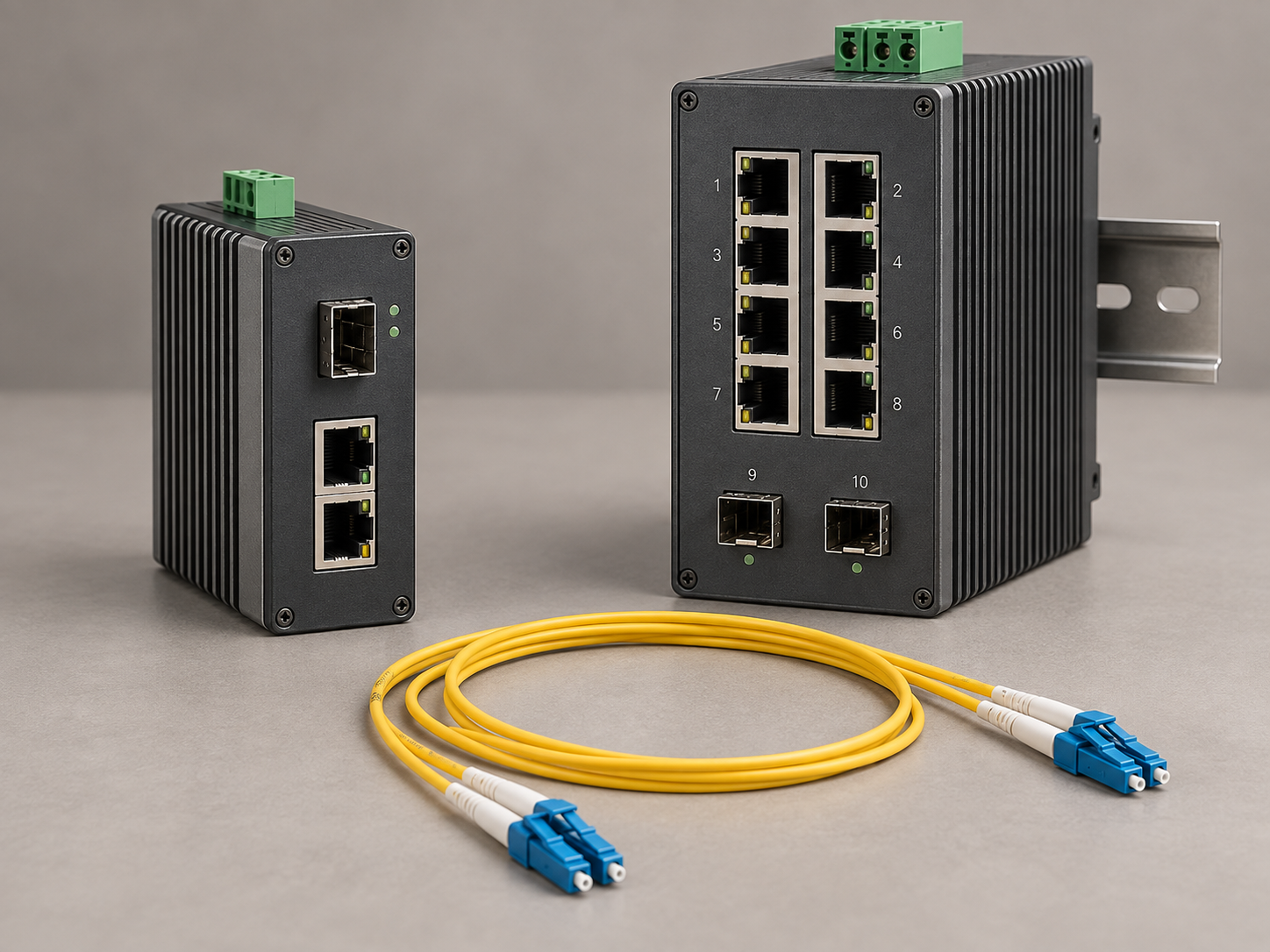
A managed SFP switch earns its place through required functions
A managed switch can be appropriate when the cabinet aggregates several endpoints or needs functions such as VLAN control, multicast handling, traffic observation or remote event reporting. Each required feature still needs model and firmware confirmation.
Management also introduces responsibilities. The site needs an addressing plan, access policy, saved configuration and a recovery process. If nobody will maintain those elements, the additional menu options do not automatically translate into better availability.
For a remote cabinet with several services, write the operational requirement first: which devices communicate, which traffic is separated, which faults must be visible and what an on-site replacement technician must restore. Then select the smallest supported architecture that meets those requirements with a documented expansion allowance.
| Project question | Converter-focused review | SFP-switch-focused review |
|---|---|---|
| How many endpoints are required now and later? | Verify the exact copper-port arrangement | Reserve usable access ports after uplinks and other roles |
| Is remote diagnosis essential? | Identify available indicators and any management support | Verify counters, logs and optical information actually exposed |
| Does traffic need segmentation? | Confirm supported frame handling and architecture | Confirm VLAN functions and accepted configuration |
| Is endpoint PoE required? | Select the correct PoE variant and supply arrangement | Check per-port capability and aggregate budget |
| What happens when fiber fails? | Verify supported fault indication or propagation | Verify the required event reporting and recovery behavior |
| How will a spare be installed? | Keep exact interface and power compatibility | Keep compatible hardware plus a tested configuration restore |
Fiber selection remains a separate engineering task
Both architectures need a compatible optical path. Check the host's supported module type and speed, the transceivers at both ends, fiber type, wavelength arrangement and optical budget. A converter does not make an incompatible pair of optics work together.
Use the route's connectors, splices and loss evidence in the review. A distance label is a starting point, not a complete acceptance test. If using BiDi modules, record the complementary transmit and receive directions so the spare at each end can be identified correctly.
For installation testing, distinguish connector inspection, end-to-end loss measurement and fault localization. Fluke Networks' fiber-testing guide describes these different tool roles. Select the evidence needed by the project instead of relying solely on the link LED of either device.
Count every power dependency at the remote site
A fiber data path still needs local power for the converter or switch. If endpoints require PoE, include their demand, cable conditions and required functions in the power design. A non-PoE converter with two copper ports cannot be treated as a PoE source because a related variant offers that feature.
Compare the complete bill of materials: device, approved supply, optical modules, enclosure accessories and any required redundancy components. Check available output under the cabinet conditions. A small converter plus several separate injectors may create more power branches and replacement parts than a suitable PoE switch, while a simple non-PoE endpoint may need none of that complexity.
Keep the thermal boundary clear. Some supplied energy leaves the cabinet for remote powered loads; losses and local device consumption remain inside. Review the actual arrangement rather than adding nameplate output watts as though all of them became enclosure heat.
Model the fault-handling work, not just the purchase price
Consider an illustrative remote-site visit requiring travel, access coordination and troubleshooting time. If a managed function can provide the particular evidence needed to avoid some visits, that benefit can be included in the comparison. It should be based on a stated operational assumption, not a promise that a managed switch eliminates field work.
Ask what the operator can learn remotely when service fails. Can the site report supply loss, interface errors or an optical receive change? Can an endpoint fault be distinguished from an uplink fault? Does the management path remain reachable during the failure being investigated?
If the answer is no, buying a managed device solely for a long feature list may not improve that failure case. Conversely, a modest diagnostic requirement can justify management when the equipment is difficult to reach. The value comes from the observation and response process that will actually be used.
Test the final combination before standardizing it
Connect the intended endpoints, optics and power arrangement. Verify link establishment, traffic at the required rate and any relevant frame or VLAN behavior. If the design depends on fault propagation or an alarm, exercise that condition in an approved test setup and observe the receiving system's response.
Include restart and replacement. For a managed switch, restore the accepted configuration to the approved spare and verify service. For a converter, confirm that the spare's exact interface, power and environmental specifications match the installation. A similar enclosure is insufficient evidence in either case.
When requesting TODAHIKA industrial fiber equipment, provide the endpoint schedule, fiber route, required diagnostics, cabinet conditions and expansion plan. Ask for alternatives against that common requirement. The right choice is the arrangement the site can operate, diagnose and replace reliably, with each required function demonstrated on the specified equipment.
Post time: Oct-01-2026


