
An industrial switch is rated for a wide ambient range. The selected optical module has a narrower limit, and the power supply begins reducing its available output before the switch reaches its upper rating. Which temperature describes the cabinet?
None of those figures alone does. The completed installation must keep every required component within its own permitted operating conditions while carrying the specified load. That means checking local temperature, component selection and available capacity together.
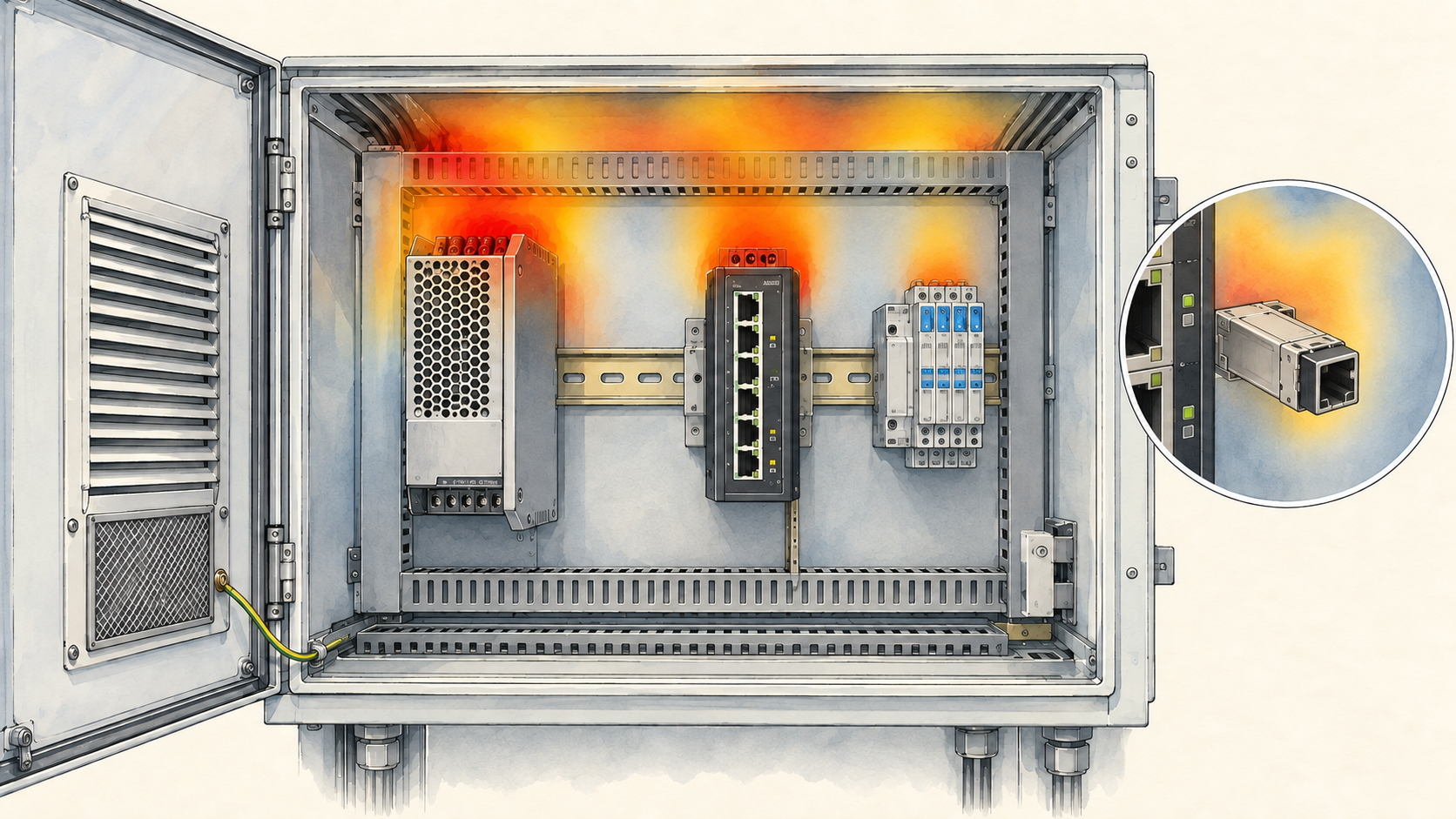
Start with a component limit register
List the exact switch variant, each installed transceiver, supply, converter and any enclosure climate-control equipment. For each item, record the operating range, the measurement definition and conditions that change its rating. Keep storage temperature in a separate column; it is not permission to operate at that temperature.
A wide-temperature claim can be variant-specific. Moxa's EDS-508A series page distinguishes available wide-temperature models, illustrating why a family name is insufficient. The same discipline applies when checking a TODAHIKA ordering code.
The TH-G510-8E2SFP page lists an operating range and non-condensing humidity condition. Confirm the current approved conditions for the exact configuration, including its PoE load and transceivers. Do not extend a switch's enclosure rating to an accessory without reviewing that accessory's specification.
| Component | Information needed | Why the headline temperature can mislead |
|---|---|---|
| Ethernet switch | Exact variant, mounting and load conditions | A family may contain different operating versions |
| Optical or copper transceiver | Approved module, ambient or case-temperature definition | A module can have a different limit from its host |
| DC supply or converter | Output available across the relevant conditions | It may still operate while supplying less power |
| Enclosure cooling equipment | Capacity, ambient range and maintenance requirements | Cooling performance depends on the installation |
| Connected accessories | Their own environmental limits | A small accessory can become the limiting item |
Ambient temperature is not a single cabinet-wide value
The weather station reports conditions outside. A sensor near the cabinet door measures one internal location. The air near a power supply or an optical module may be warmer. These observations can all be correct while describing different conditions.
Use the component manufacturer's specified measurement location and installation requirements. Where a specification concerns ambient air, do not substitute an enclosure surface reading. Where a transceiver limit refers to a defined case temperature, do not compare it directly with an unrelated air probe.
Place measurement points so the review can detect local differences. Record their locations in a photo or drawing, together with the load state and whether the cabinet door was closed. A temperature reading without those details is difficult to use later.
PoE output is not all dissipated inside the cabinet
Thermal calculations need the correct boundary just as power calculations do. If a supply and switch deliver power to cameras outside the cabinet, much of that delivered energy leaves through the cables and is consumed at the endpoints. It should not all be counted as heat generated beside the switch.
For an illustrative boundary calculation, suppose the cabinet draws 230 W electrically and delivers 190 W out of the cabinet to remote loads. If no other meaningful energy path is involved, approximately 40 W remains as internal dissipation. The figures are invented to demonstrate the balance, not to specify an actual switch.
Include the other internal equipment and relevant losses. A converter, UPS or enclosure heater can change the total. Cable losses inside the enclosure and losses along an outdoor run do not occur in the same thermal space. Keep the boundary consistent rather than adding the full PoE rating to every component's dissipation figure.
This estimate supports enclosure design, but it does not predict every local hotspot. Component spacing, airflow, orientation and the enclosure's heat-transfer properties still matter. A credible thermal review uses the estimate to select and check the arrangement, then validates the completed cabinet.
Derating can create a power problem before a temperature trip
A supply may remain within its operating range while its permitted continuous output decreases. The relevant comparison is therefore between the network's required input and the supply's available output at the local condition, not just whether the supply is “rated for” that temperature.
Use the selected supply's curve and mounting requirements. Apply any relevant input-voltage or altitude conditions as specified. Avoid adopting a generic percentage from another model's datasheet: different products have different thermal designs and limits.
If redundant sources are required, repeat the capacity check for the surviving path. A two-supply system can look lightly loaded in normal operation while one supply becomes heavily loaded after a failure. Include that operating state in the thermal and power review if the site expects it to continue indefinitely.
A closed door changes the test
An open cabinet is convenient for commissioning, but it can provide an unrealistic thermal condition. Test the final arrangement with the door, glands, filters, covers and equipment spacing in their intended state. Record any temporary fan or removed panel that would change the result.
Allow the system to approach the relevant stable condition, and continue long enough to observe the load pattern that matters. A short test after power-on may miss gradual heat accumulation. Conversely, a brief high reading during an unrelated service action may not represent sustained operation. Define the test condition and evaluation method before drawing a conclusion.
For outdoor installations, include the environmental design assumptions such as solar exposure and enclosure location. A shaded workshop test does not establish the performance of a sun-exposed field cabinet. Where controlled environmental validation is needed, specify it explicitly rather than presenting a limited site observation as qualification over the complete rated range.
Moisture needs a separate line in the review
A temperature-compatible cabinet can still experience condensation. Rittal's enclosure-moisture guidance explains the relationship between moisture, cold surfaces and dew point. The practical design question is whether the installation remains within the equipment's non-condensing requirements through the expected temperature changes.
Consider shutdown and restart as well as full operation. A cabinet that is warm while loaded may cool significantly overnight. Opening it in humid conditions can also alter the internal moisture state. Select any heating, cooling or moisture-control arrangement as part of the enclosure design and its maintenance plan.
Do not assume that increasing ingress protection alone solves every condensation case. Protection against external entry and control of the internal environment are related but distinct requirements. The completed assembly needs both reviewed where the site conditions demand them.
Make the thermal acceptance record useful for expansion
Retain the component register, load configuration, sensor positions and recorded conditions. State the margin to each applicable limit using consistent definitions. Note the conditions that were validated and those that still require separate qualification.
When adding cameras, replacing a transceiver or changing the supply, revisit both power and heat. A spare Ethernet port does not establish spare thermal capacity. The expansion review should explain how the new configuration affects internal losses and the available output of each power path.
For a TODAHIKA industrial-switch selection, provide cabinet conditions and the proposed accessories with the port requirements. Request confirmation for that complete configuration. The resulting design is easier to defend because every temperature claim has a named component, measurement boundary and operating condition behind it.
Post time: Sep-28-2026


