
You have a vision: you want to launch a line of Wi-Fi 6 routers or outdoor access points under your own brand. You want to compete with major domestic manufacturers.
However, when you contact a factory in China, their first question will always be:
“Do you need OEM or ODM?”
Choosing the wrong path can come at a high price. One approach can save you money and bring your product to market within 30 days; another approach, while enabling comprehensive innovation, requires upfront investment in molds and R&D.
At Toda, we offer both models of service to hundreds of clients worldwide. This concise guide will help you determine which manufacturing service is better suited to your current stage of business.
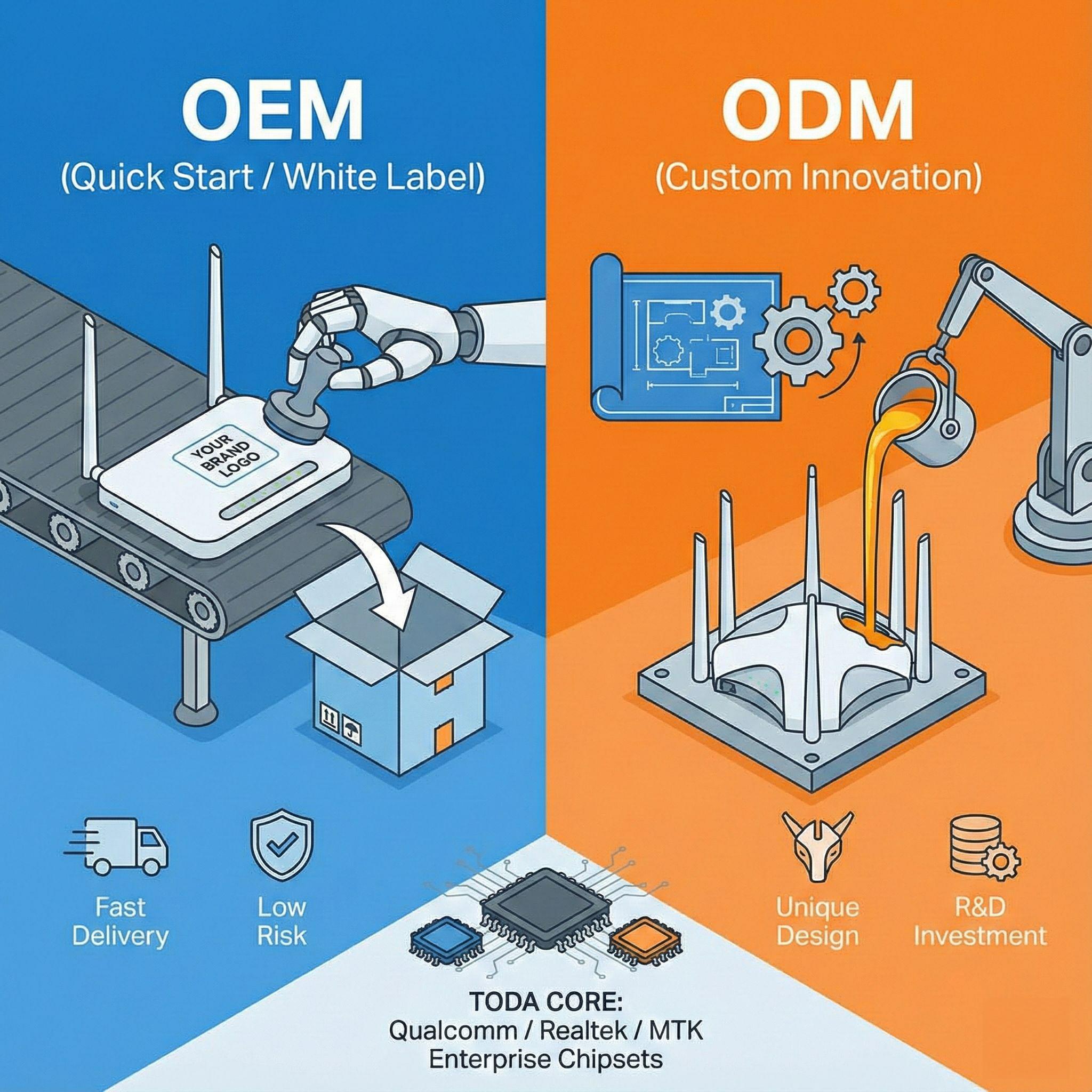
1. What is OEM? (The Quick Start)
OEM stands for Original Equipment Manufacturer. In the networking industry, this is often referred to as “white label manufacturing” or “private label manufacturing”.
How it works: Toda already has finished products—for example, dual-band gigabit routers—that we design, test, and certify. You select this product, and we customize the branding for you.
What you can customize in OEM:
-
Logo: We print your brand logo directly on the device casing.
-
Packaging: We design retail packaging boxes based on your design drafts and local language requirements.
-
Label: Your model number and serial number are displayed on the label at the bottom of the device.
-
Basic Firmware Skin: We modify the router login page (GUI) to display your logo and brand colors.
Who is OEM best for?
-
Internet Service Providers (ISPs): You need to quickly provide your users with thousands of standardized ONUs or routers.
-
Distributors & Trading Companies: You want to expand your product line but don’t want to spend $50,000 on R&D.
-
Startups: You want to test the market with low risk.
Toda’s Advantage: Because we keep stock of PCBA (motherboards) and casings ready for production, the delivery time is very short (usually 25–35 days).
2. What is ODM? (Customized Innovation)
ODM stands for Original Design Manufacturing. This applies to brands that want to create unique products that don’t yet exist on the market.
How it works: You come to Toda with a specification sheet or concept. For example, you might say: “I need an outdoor AP with four antennas, a specific heatsink design, and support for a specific proprietary VPN protocol.” Our engineering team will then build the product for you from scratch.
What does ODM include?
-
Industrial Design (ID): Creating entirely new shapes for plastic or metal casings. This requires investing in mold making.
-
Hardware Design: We redesign the PCB layout to accommodate specific ports (e.g., adding SFP ports or SIM card slots).
-
Deep Software Development: Customizing drivers, adding specific features (such as TR-069 management), or integrating with your own cloud platform.
Who is ODM best for?
-
Established Brands: You need a unique appearance to differentiate yourself from TP-Link or D-Link.
-
Specialized Projects: You need equipment that must withstand harsh environments (such as mining or maritime use) where standard plastic routers would fail.
⚠️ The Reality Check: The ODM model requires Non-Recurring Engineering (NRE) costs for mold making and R&D. The time-to-market is also longer (usually 3–6 months).
| Feature | OEM (Private Label) | ODM (Custom Design) |
| Development Cost | Low (Zero tooling fees) | High (Molds + R&D fees) |
| Time to Market | Fast (30-40 Days) | Slow (3-6 Months) |
| Uniqueness | Low (Same hardware as others) | High (Unique to your brand) |
| Minimum Order (MOQ) | Lower (e.g., 500-1000 pcs) | Higher (e.g., 3000-5000 pcs) |
| Best For | Speed & ROI | Brand Differentiation |
Why Partner with Toda?
Regardless of whether you choose an OEM or an ODM, the most important factor is the quality of the chipset.
Unlike some small workshops that use recycled or unstable chips to cut costs, Toda strictly uses original enterprise-grade chips from Qualcomm, Realtek, and MediaTek (MTK).
This means that even if you choose a simple OEM model, the core components of the device are robust, reliable, and capable of high performance.
Still Hesitating?
Here is the path many of our successful clients take: Start as an OEM to boost sales and generate cash flow. Once they reach a certain sales volume, they transition to ODM to create a flagship product that defines their brand.
Let’s discuss your development plan. Please tell us your budget and target market, and we will recommend a suitable entry point for your brand.
[Contact the Toda Product Team]
Post time: Dec-11-2025


