
Depending on the terrain, the cost of laying fiber optic cable ranges from $10 to $30 per foot. If you’re an Internet Service Provider (ISP) trying to connect an agricultural community or a mountain village five miles from the main data line, this is simply not cost-effective. You will never recoup the installation cost from the monthly subscriptions of 20 remote households.
This is precisely why the business model of Wireless Internet Service Providers (WISPs) has flourished globally.
WISPs don’t dig in the ground; instead, they utilize the air. They efficiently solve the “last mile” access problem by broadcasting high-speed internet signals directly to receivers on users’ rooftops via a central signal tower.
Toda’s hardware makes all of this possible. If you plan to build or upgrade your WISP network in 2026, here is what you need to know about deploying remote CPE (Customer Premises Equipment) bridges.
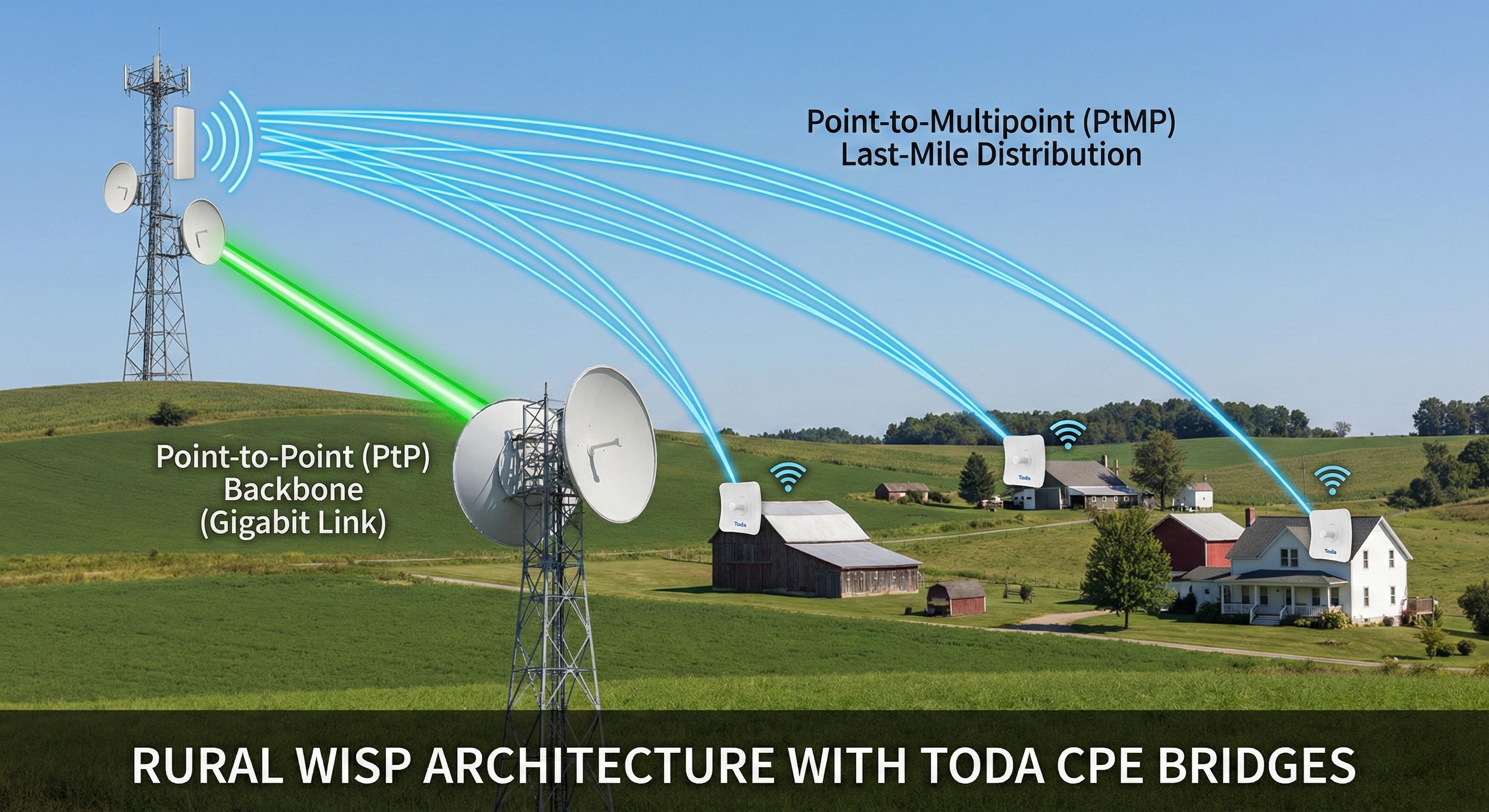
Architecture: PtP and PtMP Networks
Providing internet service in rural areas typically requires a combination of two wireless setups:
1. Point-to-Point (PtP) – The Backbone Network
Imagine a Point-to-Point connection as an invisible fiber optic cable. You use a pair of highly directional antennas (typically parabolic dish antennas) to transmit the main internet signal from the city to base stations in rural areas. Within line-of-sight, a good 5GHz or 5.8GHz PtP link can transmit gigabit speeds over 10 to 20 kilometers.
2. Point-to-Multipoint (PtMP) – The Distribution
Once the signal reaches your village cell tower, you need to distribute it to each household. You install a sector antenna (base station) on the tower, which broadcasts the signal over a wide angle (e.g., 90 or 120 degrees). Then, a CPE device is installed on the roof of each user’s house, pointing directly back at the cell tower.
Choosing the Right CPE Hardware for a WISP
For a WISP, the CPE is the most critical hardware. Constantly exposed to the elements, it determines whether customers can reliably watch streaming video or if they will angrily call customer service.
When evaluating CPE hardware from manufacturers like Toda, here are the specifications that truly matter in real-world applications:
-
High Antenna Gain (dBi): You can’t defy the laws of physics. To receive a signal from a tower 3 miles away, you need a high-gain directional antenna. While a standard 12dBi or 14dBi panel works for short distances, truly long-range rural deployments require an 18dBi to 23dBi built-in antenna to ensure the signal penetrates sparse foliage and inclement weather.
-
Weatherproof Sealing & Surge Protection: Rural areas suffer from severe weather and lightning strikes. Cheap plastic routers can be destroyed by condensation within a year. Toda CPEs are designed to meet strict IP65/IP67 protection standards. More importantly, our PCBA circuit boards feature robust ESD and surge protection, safely grounding the device to protect indoor routers from nearby lightning strikes.
-
Ease of Installation: For WISP installers, time is money. Toda CPE devices feature an intuitive physical design (like pole-mount straps with tilt indicators) and smart software tools, including LED signal strength indicators on the back of the device. Your technicians don’t need to constantly stare at a laptop screen to know when optimal alignment is achieved.
The Business Perspective: Reducing the “Cost Per User”
If you purchase CPE equipment from a well-known legacy brand, the receiver alone could cost $100 to $150 per household. Add the costs of the indoor router, pole mount, cabling, and labor, and the Customer Acquisition Cost (CAC) becomes staggering. It could take six to eight months of subscription fees just to break even.
This is where Toda changes the WISP business model.
Because we are a direct manufacturer, we offer the exact same performance—powered by Qualcomm and MediaTek chipsets—at prices far lower than the major brands.
-
Faster ROI: By significantly reducing hardware costs, you can recoup your investment from new users in 2 months instead of 6 months.
-
White Label Customization (OEM): We offer in-depth OEM services. We can print your company’s WISP logo directly on the CPE equipment and customize the login software interface. When customers look at their rooftop, they see your brand, not ours.
Ready to Expand Your Network Coverage?
The rural broadband market is a race. The first WISP to deliver a consistent 100Mbps connection to neglected agricultural communities will win that market for the next decade.
Don’t let overpriced hardware hinder your expansion.
[Contact Toda Today] to request a test sample of our 5GHz remote CPE bridge. Install it on your tower, run your bandwidth tests, and see how we can help you achieve profitable connectivity for unconnected users.
Post time: Feb-25-2026


