
For logistics managers, nothing is more frustrating than a handheld scanner displaying a “connection lost” error.
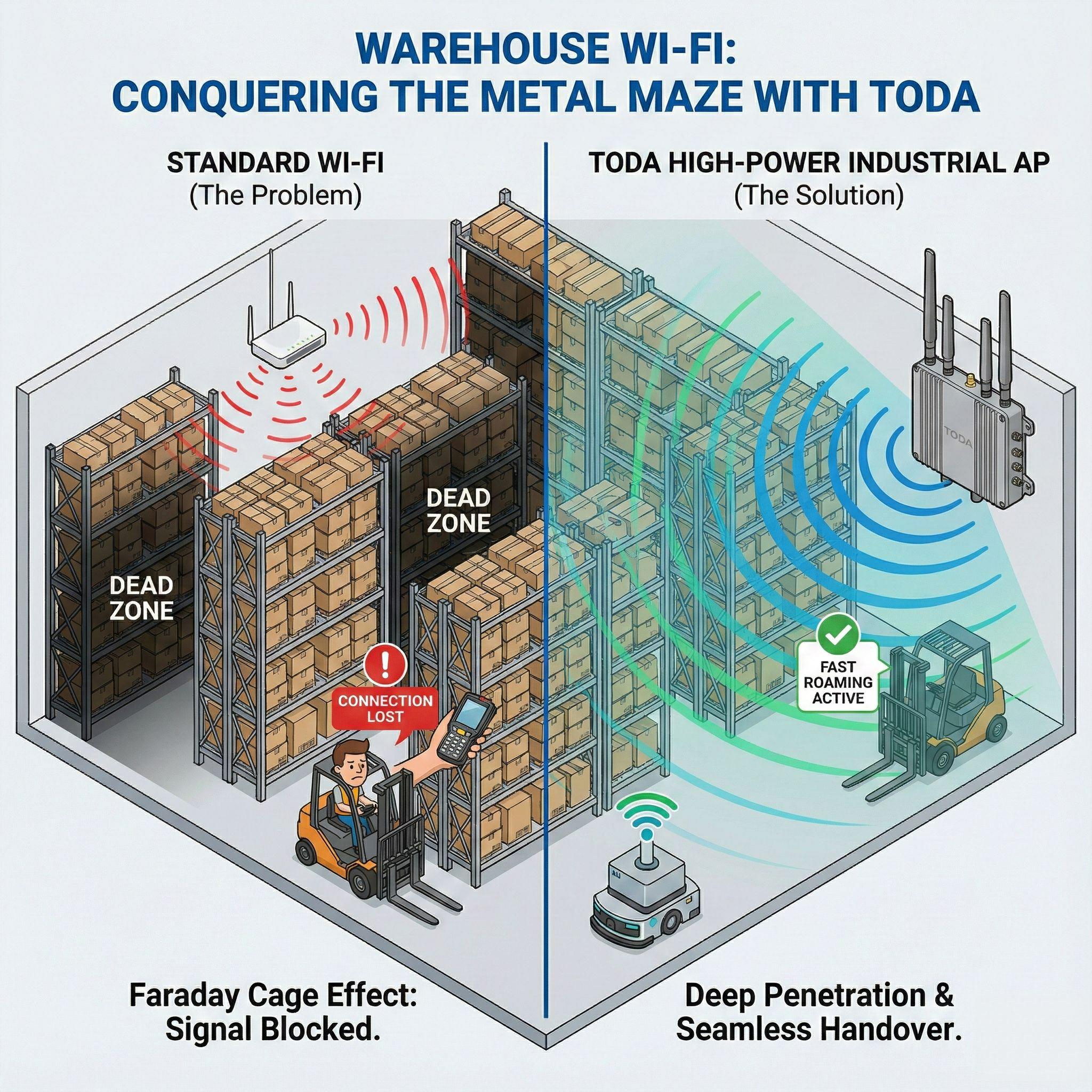
In a busy warehouse, time is money. Efficiency drops immediately if forklift drivers have to stop, wave scanners, or drive back to a location with better signal to upload data.
For system integrators, warehouses are arguably one of the most challenging environments to cover. You need to contend with high ceilings, vast open spaces, and the biggest enemy of Wi-Fi signals: metal.
At Toda, we help clients design networks for their global logistics centers. This article will explain why standard office Wi-Fi doesn’t work properly in warehouses and how high-power access points (APs) can solve this problem.
Enemy: Faraday Cage Effect
Why is the signal so poor even though you installed an expensive router?
Most warehouses are essentially giant steel-framed mazes. When you stack goods (especially liquids or metal parts) on these metal shelves, you create a dense barrier that can absorb and reflect radio waves.
A standard office wireless access point (AP) typically has a transmit power of around 20 dBm. This is sufficient for an office with drywall walls. However, in a warehouse, the signal weakens before reaching even the third channel.
Solution: High-power industrial-grade wireless access points
To overcome interference, you need powerful antennas and smarter antenna designs.
1. Why “high power” is important
Toda’s industrial and outdoor access points (APs) feature a high-gain power amplifier (PA) design. Unlike consumer-grade routers, these devices can transmit at higher dBm power, allowing signals to travel further into corridors.
Expert Tip: We generally recommend using our outdoor wireless access points (IP67 protection rating) inside warehouses. Why? Because they feature a more robust radio module and better heat dissipation than standard indoor plastic devices. They are better able to withstand the dust and extreme temperatures in uncontrolled warehouses.
2. Fast roaming is crucial (802.11k/v/r)
Coverage is only half the battle; the other half lies in mobility.
Forklifts and Automated Guided Vehicles (AGVs) move at high speeds and need to switch instantly from access point “A” to access point “B”. If the switching process lasts even less than 2 seconds, the scanning session will time out, and the operator must log in again.
Toda’s AC controller can actively manage this “switching” process. It forces the device to switch to the strongest signal before the connection is lost, thus ensuring zero downtime for vehicles in motion.
Installation method: Ceiling-mounted or wall-mounted
The placement of the access point (AP) is just as important as the AP itself.
Incorrect practice: Installing wireless access points on the ceiling in the middle of a hallway. This usually leads to signal overlap and interference.
Toda Strategy: For high-density racks, we generally recommend installing APs at the end of the aisle, using directional antennas, or using an interleaved pattern on the ceiling to transmit signals along an unobstructed path rather than trying to get them through the rack.
Why does a warehouse need Wi-Fi 6?
You might think Wi-Fi 6 is just about speed, but for warehouses, it’s about efficiency.
Wi-Fi 6 (802.11ax) introduced a feature called OFDMA. You can think of old Wi-Fi as a delivery truck that can only deliver one package at a time. OFDMA, on the other hand, allows that delivery truck to deliver multiple packages to different customers simultaneously.
In a warehouse with 50 scanners, 10 printers, and 5 AGVs constantly sending small data packets, Wi-Fi 6 significantly reduced “queue” time, making the network feel smoother and faster.
In conclusion: There is no room for compromise on hardware.
Warehouse networks are critical infrastructure. Using home-grade repeaters or low-end switches to save a few dollars upfront will cost you thousands of dollars in lost productivity later on.
Need a robust solution for your logistics customers? Toda offers a full range of high-power wireless APs, industrial PoE switches, and AC controllers designed for the most demanding industrial environments.
Contact us for a free on-site survey and consultation.
Post time: Nov-29-2025


