
A remote site can have a clear view of the sky and still be difficult to connect. A haul truck blocks a radio path. A cabinet overheats in afternoon sun. A backup connection shares the power supply that just failed. These are different problems, and buying a more powerful access point will not resolve all of them.
For mining contractors, oil-field operators and their network integrators, the first purchasing decision is the architecture. Identify what must communicate, where it moves and how it should behave during an interruption. Only then can “industrial grade” become a set of verifiable requirements.
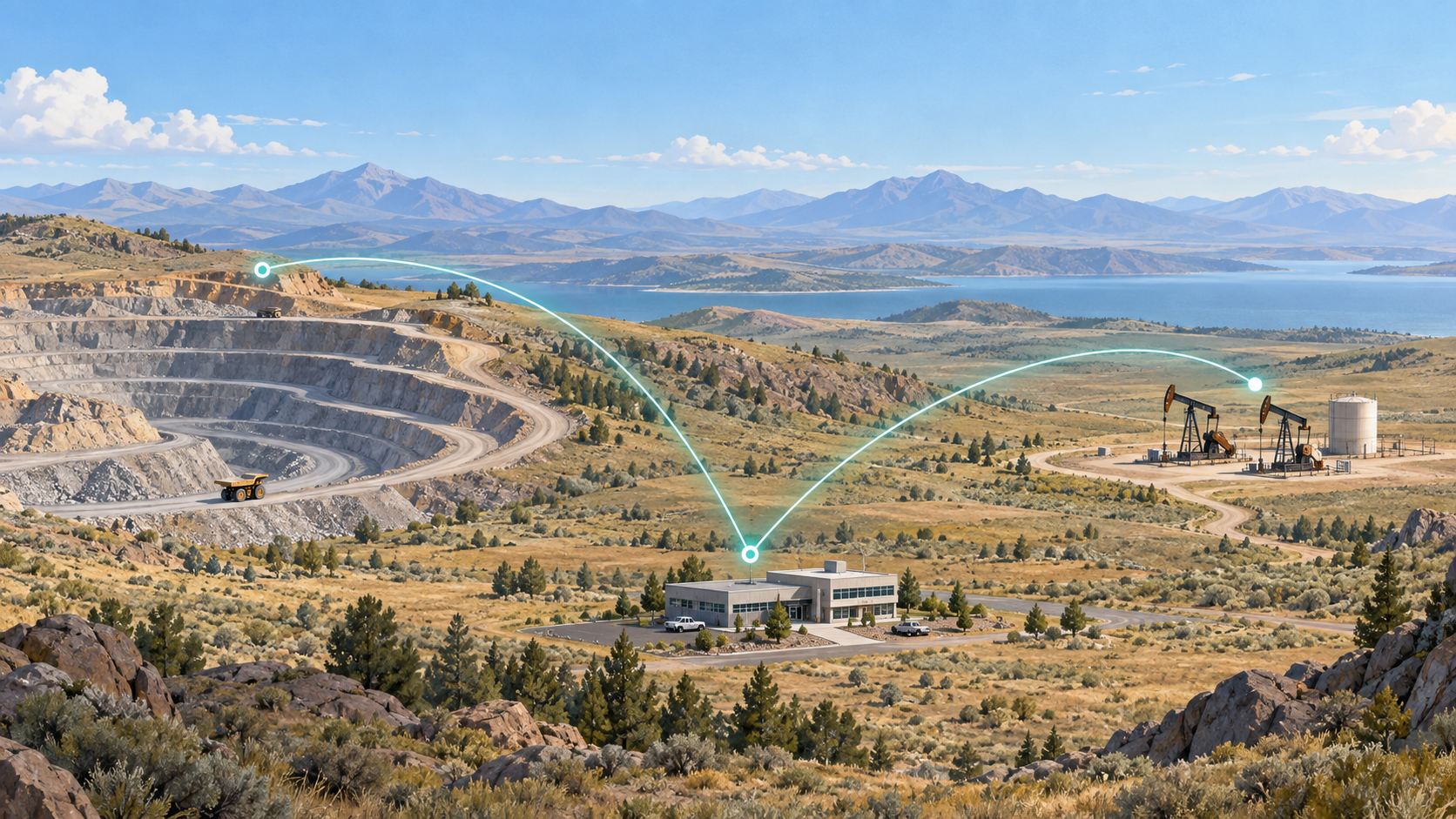
Editorial illustration: a conceptual remote-site network, not a photograph of a customer installation or an engineered coverage plan.
Define the service before selecting the radio
An office connection, a camera stream and a machine-control link have different acceptance criteria. Write down the endpoints, traffic direction, busiest period and acceptable interruption for each service. The process owner must set requirements for control or safety-related systems, working with the equipment manufacturer and qualified engineering team.
Cisco’s August 2026 above-ground mining design guide emphasizes validating actual workflows along operating routes, including vehicle movement, traffic load and changing site geometry. That is a useful procurement lesson: coverage on a drawing does not prove an application works throughout a shift. Cisco above-ground mining wireless design.
Keep business connectivity, maintenance access, video and operational traffic distinguishable in the design. Record which services must continue locally if the external connection fails.
Give backhaul and local access separate jobs
Backhaul connects the site or field area to the wider network. Local access connects its devices. They may use different media.
| Link requirement | Candidate approach | Main question to settle |
|---|---|---|
| Stable connection between fixed buildings | Fiber where installation is practical | Can the route be protected and repaired? |
| Connection across open terrain | Engineered point-to-point wireless | Does the path meet its clearance and availability targets? |
| Nearby staff or maintenance devices | Appropriately specified Wi-Fi | Does coverage hold with actual clients and obstacles? |
| Dispersed or moving assets | Evaluated cellular or specialist industrial wireless | Are coverage, spectrum access and endpoint support suitable? |
These are design candidates, not interchangeable replacements. Cellular service may be public or private; either approach needs an assessment of coverage, capacity and operating responsibility. Satellite can be assessed for a surface site’s external connection, with application latency and service terms included in the decision.
Survey the radio path, including what may change
For a fixed outdoor link, collect endpoint coordinates, mounting heights, terrain profiles, nearby structures and the required data rate. Inspect the path on site. A terrain model can miss a stockpile, a new building or vegetation near an antenna.
Optical line of sight is only part of the check. The Fresnel zone is a volume around the direct path; intrusion into it can reduce performance. Cambium’s installation guidance describes both clearance and the effects of nearby obstacles. Use the selected radio’s planning requirements rather than a universal distance claim. Cambium cnVision installation guide.
Link-planning tools can estimate throughput and availability from equipment, path and performance inputs. Cambium also calls for comparing installed path loss with the prediction. Keep that comparison in the commissioning record and reassess after material terrain or mounting changes. Cambium LINKPlanner concepts.
Treat underground workings as a separate network
A surface tower does not establish coverage through rock into underground galleries. Communications must be brought into the workings and distributed along the required routes.
Cisco’s industrial-site reference describes underground designs using installed fiber or other cabling alongside wireless access, with technologies such as industrial Wi-Fi and private LTE selected for different applications. Public towers or satellites above ground do not supply direct coverage deep underground. Cisco industrial-site architecture, underground mine section.
Tunnel geometry, junctions, moving equipment, power access and the expansion of workings all belong in the survey. Have the specialist mine communications team determine architecture and emergency-communication requirements before requesting quantities of APs or repeaters.
Make “industrial grade” measurable
Request the operating temperature range, permitted humidity, ingress protection, vibration and shock evidence, power limits and installation conditions for the exact orderable model. Include antennas, cable entries, connectors and the cabinet in that review.
Industrial products themselves have variants. For example, Moxa lists different operating-temperature ranges for standard and wide-temperature AWK-3252A models, alongside separate power and vibration specifications. This illustrates why a family name or rugged-looking enclosure is insufficient evidence. Those are Moxa specifications, not specifications for toda equipment. Moxa AWK-3252A technical data.
Check hazardous-area suitability independently
IP67 is an ingress-protection designation, not proof of explosion protection. IEC 60529 covers enclosure protection; suitability for explosive atmospheres requires a separate assessment. IEC 60529 scope.
Where flammable gases, vapors or combustible dust may be present, start with the site’s documented area classification. HSE guidance links zoning to the likelihood and persistence of an explosive atmosphere and to appropriate equipment selection. Requirements differ by jurisdiction and application, including mining; the site’s qualified specialists must establish the applicable regime. HSE explosive-atmosphere guidance.
For equipment offered as IECEx certified, verify the certificate number, current status and precise model against the official record. Have the responsible specialist check the protection marking, environmental limits, special conditions and proposed assembly, including accessories and cable entries. ATEX and IECEx are distinct systems; a generic logo or a certificate for another model is inadequate. IECEx certification FAQ.
Commission the failure path as well as the normal path
Review battery autonomy, source independence and recovery after power returns. Two radios on one failed supply provide no power resilience. Agree monitoring for link health, device temperature, supply state and application availability, with a named response owner.
Before handover, test the approved failure scenarios and record recovery behavior. Include spare-part locations, configuration backups and maintenance access in the operating plan.
For a discussion with toda, provide the site layout, distances, traffic needs and the engineering team’s environmental and certification requirements. Request model-specific evidence before considering any equipment suitable. This article does not establish industrial or hazardous-area approval for toda products.


