
The low-cost network equipment market hides a financial risk that most buyers discover only when it is too late.
Consider a distributor who ordered 2,000 low-cost gigabit switches from an unverified factory. While the upfront unit price was attractive, critical failure points emerged within three months of deployment.
Power supplies failed during minor electrical storms, and Ethernet ports froze under heavy traffic loads. The Dead on Arrival (DOA) rate reached 4%, while the Return Merchandise Authorization (RMA) rate climbed to 7%.
For B2B distributors and system integrators, high failure rates destroy profitability. Upfront savings are quickly erased by return freight, emergency site visits, and damaged client relationships.
At Todahika, operational reliability is a baseline engineering requirement for enterprise networks. Our mass production lines consistently maintain a yield rate exceeding 99.9%.
Here is how our quality control process identifies defects before any equipment leaves our warehouse.
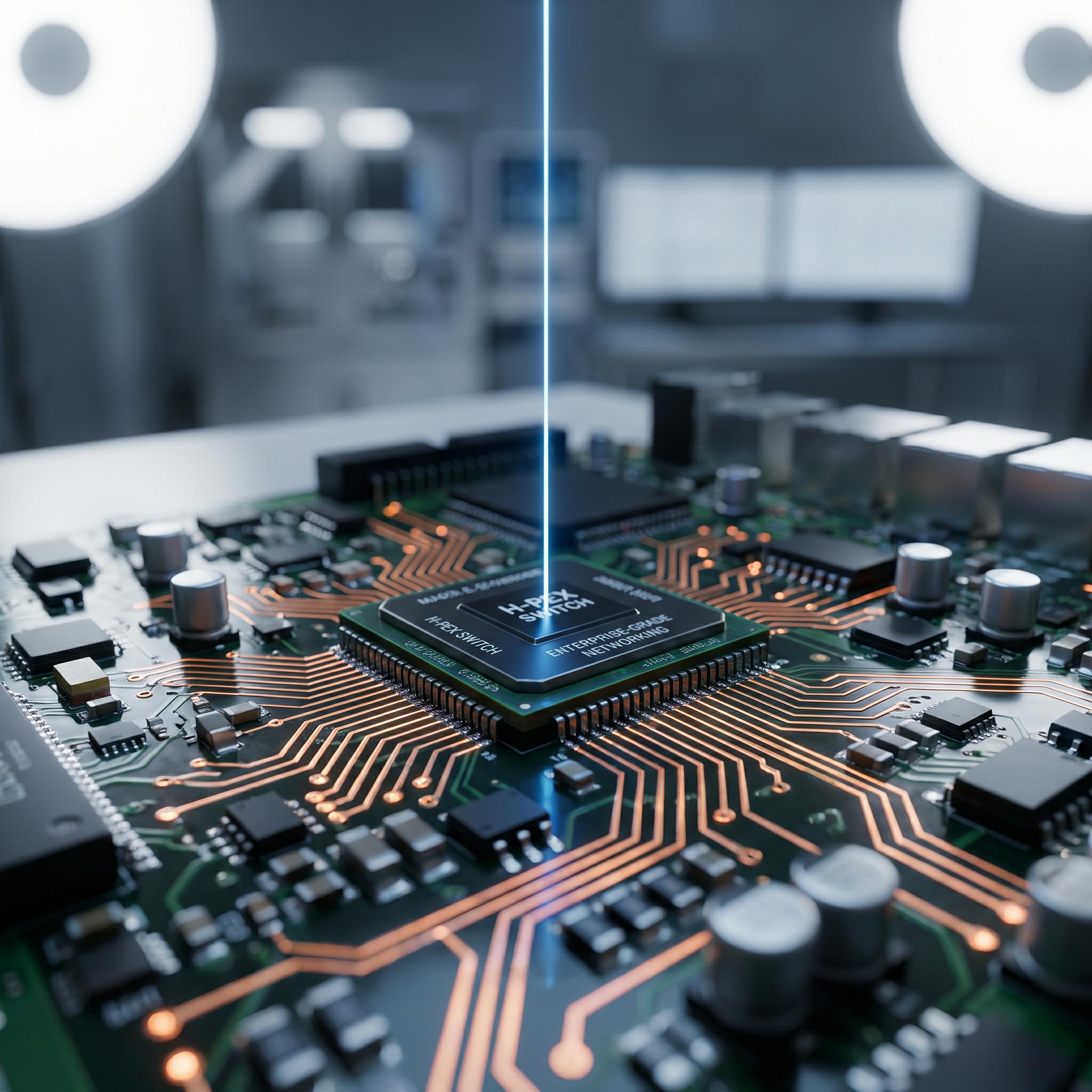
1. Incoming Quality Control (IQC): Eliminating Gray-Market Components
A network switch’s long-term reliability depends on the quality of its smallest components.
To reduce costs, low-end manufacturers often source silicon wafers, refurbished ICs, or low-grade electrolytic capacitors from open spot markets. These inferior capacitors dry out and leak after continuous operation under elevated temperatures.
The Todahika Standard: Quality control begins well before SMT assembly. We enforce strict Incoming Quality Control (IQC) protocols:
-
Direct Sourcing: All primary switching silicon (Broadcom, Realtek, Qualcomm, MediaTek) is sourced directly from original manufacturers or authorized Tier-1 distributors.
-
Industrial-Grade Selection: We specify high-temperature solid-state capacitors and industrial power transformers rated for 24/7/365 continuous operation.
-
Batch Verification: Every component shipment undergoes sample testing for electrical resistance, thermal tolerance, and lead oxidation prior to production.
2. Automated SMT Precision: 3D SPI and 3D AOI Inspection
Most hardware failures stem from poor solder joints on the printed circuit board (PCB) rather than defective silicon. Cold solder joints, solder bridges, or misaligned surface-mount components cause intermittent crashes that are difficult to troubleshoot on-site.
To eliminate human error during Surface Mount Technology (SMT) assembly, Todahika utilizes multi-stage automated optical inspection:
-
3D SPI (Solder Paste Inspection): Before chip placement, an automated laser measures the exact volume, height, and alignment of solder paste applied to the bare PCB pads.
-
3D AOI (Automated Optical Inspection): After reflow soldering, high-resolution cameras inspect every solder joint from multiple angles. If a resistor placement deviates by a fraction of a millimeter or a micro-bridge forms, the board is automatically isolated and production halts.
3. 100% Full-Load Burn-In Testing
Burn-in testing is where low-cost factories cut corners to save electricity and accelerate delivery cycles. Many facilities merely power on a device for five seconds, confirm the status LED illuminates, and package the unit.
A brief power-on test cannot detect thermal defects or component instability under load.
The Todahika Standard: Every active network device—from a 5-port PoE switch to an outdoor Wi-Fi 6 access point—must pass our burn-in laboratory protocol:
-
Devices are placed in a high-temperature environmental chamber maintained at 45°C to 50°C.
-
Units operate continuously for several hours under 100% PoE power load and maximum data throughput.
-
Any ASIC micro-defects or thermal runaway conditions trigger failure inside our factory chamber rather than inside a client’s server rack.
4. Environmental and Electrical Stress Testing
Real-world deployments expose hardware to severe operational stress, including line surges, static discharge, transport vibration, and handling drops.
Before any Todahika product design enters mass production, production samples undergo rigorous laboratory validation:
-
ESD (Electrostatic Discharge) Testing: Ports and enclosures undergo high-voltage discharges (up to 8kV contact / 15kV air) to ensure ESD diodes properly divert energy without CPU lockups.
-
Lightning Surge Protection: Ethernet ports undergo differential and common-mode surge testing (4kV to 6kV) to simulate lightning strikes on long cable runs.
-
Vibration and Drop Testing: Packaged units undergo multi-axis vibration table and drop testing to confirm internal heatsinks, power supplies, and chassis components survive international shipping.
The Bottom Line for B2B Buyers
Partnering with Todahika for OEM/ODM manufacturing or brand distribution provides commercial-grade hardware built for long-term deployment.
A 99.9% yield rate directly protects your net operating margins. Reducing RMA handling and technical support volume allows your team to focus on expanding your client base.
Contact the Todahika B2B team to request evaluation samples or arrange a production facility tour.
Post time: Jul-05-2026


