
A switch proposal says “TSN ready,” but the application requires a defined cycle, bounded delivery behavior and interoperability with existing controllers. The phrase does not reveal which functions are implemented, which profile applies or how the system will be configured and tested.
Time-Sensitive Networking is a family of capabilities and standards, not one universal feature that can be checked on a product comparison sheet. A purchasing requirement should translate the application’s needs into specific supported functions, versions, profiles and evidence across the complete communication path.
Start with the application’s timing requirement
Identify the traffic sources and destinations, message sizes, intervals, acceptable delay variation and loss behavior. State the required operating and failure conditions. A periodic control flow and an occasional maintenance transfer place different demands on the network even if both use Ethernet.
Define the measurement boundary. A switch’s forwarding delay is not the same as application-to-application latency, which can include endpoint processing and scheduling. If the requirement concerns a controller receiving usable data by a deadline, the acceptance test must observe that outcome.
Also identify what the application vendor requires. A generic networking feature list cannot replace the controller, drive or system architecture’s interoperability requirements. The relevant profile and endpoint support may narrow the available designs before switch selection begins.
Replace the umbrella term with exact capabilities
The IEEE 802.1 TSN Task Group lists standards covering timing, traffic handling, reliability and application profiles. Examples include IEEE 802.1AS for timing and synchronization and IEEE 802.1CB for frame replication and elimination. Industrial automation also has the IEC/IEEE 60802 profile, which addresses the use of selected capabilities in that domain.
A vendor response should identify the exact standard edition, implemented options, role and firmware support relevant to the project. Support for one TSN-related function does not establish support for every other function or profile. A roadmap item is also different from a capability available in the shipped release.
Ask what evidence supports the claim: documentation, interoperability results, conformance assessment where applicable and a reproducible system demonstration. Keep those categories separate. A successful demonstration under one configuration does not automatically establish full profile conformance.
Include endpoints and configuration, not only switches
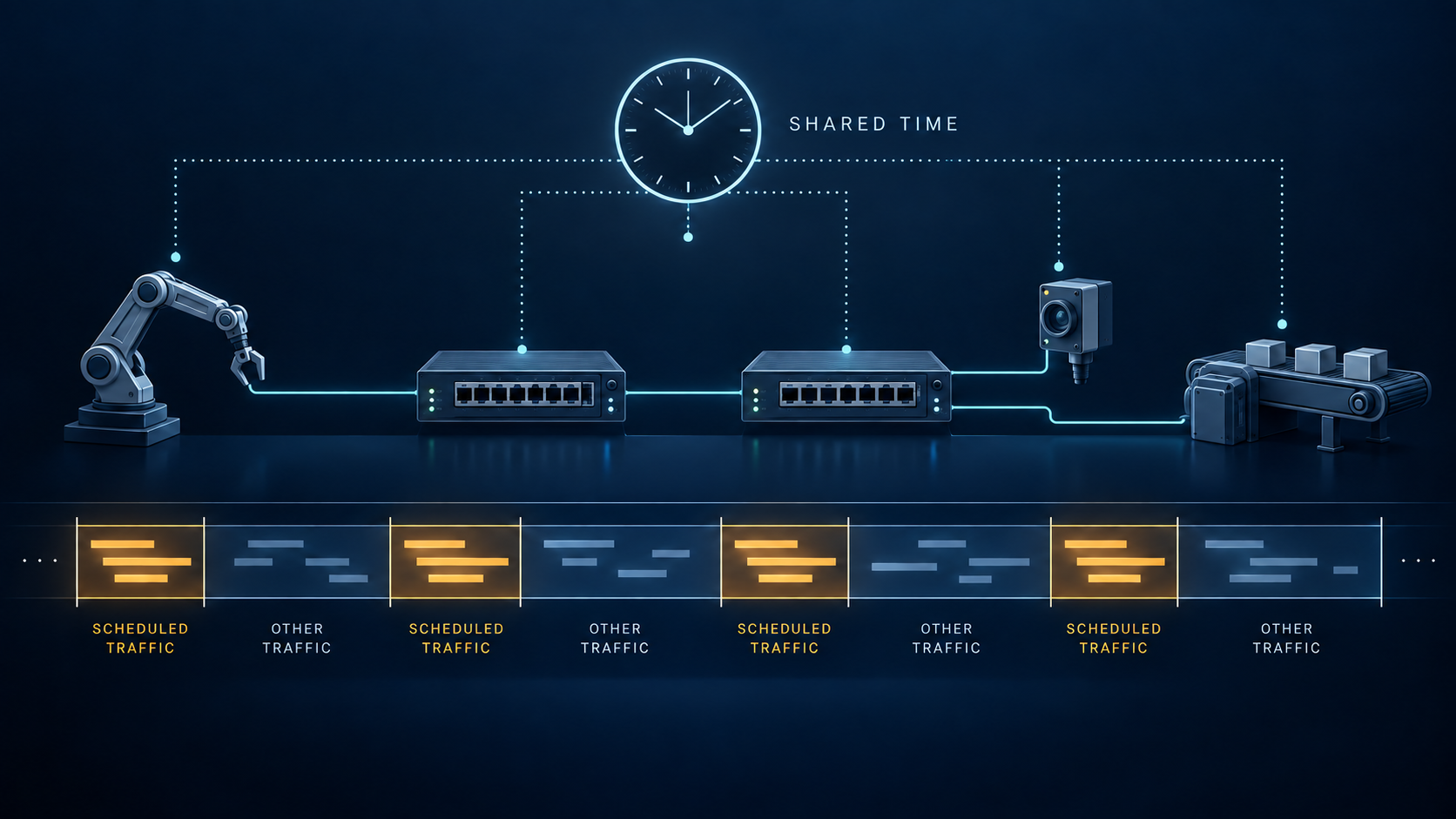
A time-aware network depends on more than forwarding hardware. Endpoints must generate and consume traffic as required, the timing system must behave appropriately and configuration must establish the intended treatment of flows. A capable switch cannot make an arbitrary unsynchronized application deterministic by itself.
Identify the time source, synchronization roles, configuration tools and responsible owner. Confirm how parameters are provisioned, checked and preserved across restart. A design that works only after undocumented manual adjustments is difficult to maintain or reproduce on a spare.
List every device and link along the required path, including media converters, gateways and any non-TSN segment. Determine their effect using the chosen architecture and application requirements. Do not assume that a single nonparticipating component is either harmless or automatically unacceptable without examining the design.
Separate ordinary priority from a timing guarantee
VLAN priority and conventional QoS can be useful, but the presence of priority queues does not by itself prove a bounded end-to-end delay under the required traffic conditions. The result depends on scheduling, traffic admission, competing load and the behavior of the complete path.
Similarly, time synchronization alone does not reserve bandwidth or define traffic scheduling. A precise shared clock and an appropriate forwarding design address related but different problems. The specification should identify which mechanisms provide each required property.
Avoid turning a low average latency result into a worst-case guarantee. A benchmark must state traffic profiles, topology, configuration, measurement method and conditions. A bound claimed for one set of assumptions may not hold after adding flows or changing the path.
Build an evidence matrix around the proposed system
| Requirement area | Supplier or integrator response needed |
|---|---|
| Application profile | Exact profile, edition, role and required options |
| Timing | Supported synchronization behavior and validation method |
| Traffic handling | Implemented functions and configuration for the defined flows |
| Endpoints | Compatible hardware, software and traffic behavior |
| Management | Provisioning, diagnostics, backup and restoration workflow |
| Reliability | Defined failure cases and application recovery requirements |
| Evidence | Test scope, equipment identities and unresolved limitations |
This matrix is an inquiry structure, not a complete TSN conformance specification. The actual requirements must be developed from the selected profile and application. Its purpose is to prevent a broad marketing phrase from hiding unanswered implementation questions.
Test normal traffic, interference from other flows and recovery
Use the intended endpoints and representative competing traffic in a controlled setup. Measure the required application behavior with suitable timestamping and known resolution. Record the timing status and configuration with the results so an apparently good run can be understood.
Exercise the failure and restoration conditions required by the application architecture. Clock-source changes, link interruption and device restart can have different effects. A steady-state test cannot establish recovery behavior, and a recovered Ethernet link does not necessarily mean the application has resumed its required timing.
Keep the test within an approved environment and procedure. A production control network should not be subjected to arbitrary traffic or timing changes simply to explore whether a feature works.
Keep product claims within verified scope
TODAHIKA’s industrial switch portfolio includes products with different capabilities. This article does not assert that an ordinary managed model supports TSN, a particular profile or a guaranteed timing bound. Request a model-specific technical response before including any such capability in a project design.
If the proposed unit does not provide the required functions, select an appropriate architecture or product rather than relabeling conventional management features as TSN. A documented limitation is useful information for the buyer.
A defensible TSN requirement connects the application, profile, hardware, software, configuration and test evidence. Once those elements are explicit, the buyer can evaluate a real engineering proposal instead of relying on the word “ready.”
Post time: Nov-11-2026


